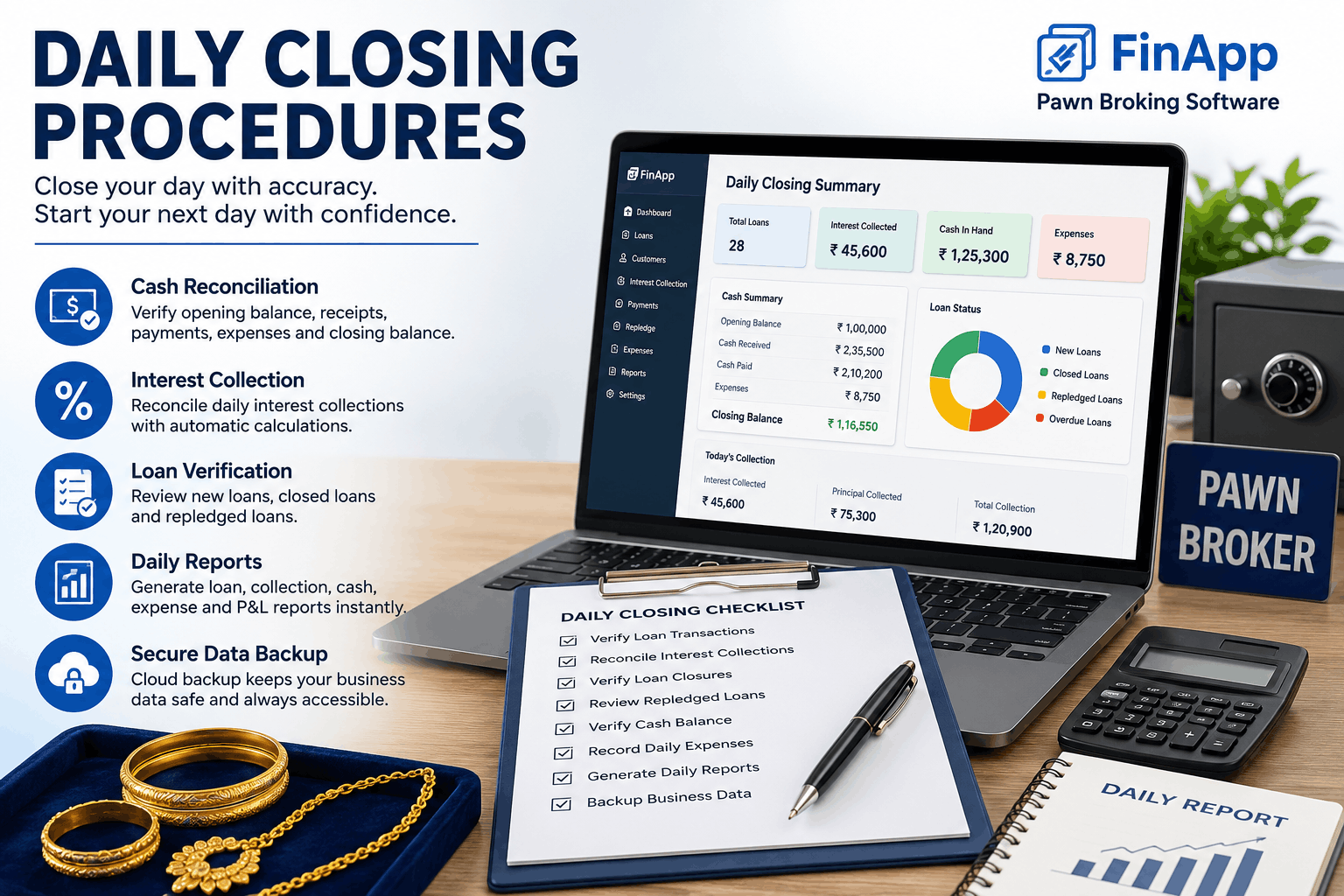
A Day in a Modern Pawn Shop: From Customer Entry to Loan Closure

A Day in a Modern Pawn Shop: From Customer Entry to Loan Closure
Discover how modern pawn shops manage customers, collateral, loans, interest, payments, follow-ups, and loan closure using pawn broking software.
Running a pawn shop involves many daily activities such as customer registration, collateral management, loan processing, interest calculation, payments, reminders, and loan closure. When these activities are handled manually, even a small mistake can create extra work.
Modern pawn broking software helps pawn businesses manage these daily operations in one place. Let us look at how a typical day in a modern pawn shop works, from customer entry to loan closure.
1. Customer Entry and Registration
The day usually starts with customers visiting the pawn shop for a new loan, repayment, renewal, or enquiry.
The staff may need to record important customer information such as:
- Customer name and contact details
- Address
- Identification details
- Previous loan information
- Required documents
A digital customer management system can make this process faster and reduce repeated data entry.
2. Checking the Collateral
For a gold loan or other collateral-based loan, the staff records the details of the pledged item.
For example, in a gold loan, the system may store:
- Gold item description
- Gross weight
- Net weight
- Purity
- Valuation
- Loan amount
- Pawn ticket details
Keeping these details digitally makes it easier to find the information when the customer returns.
3. Creating the Loan
After checking the customer and collateral details, the staff creates the loan.
A pawn broking software system can help staff enter the loan amount, interest rate, loan date, due date, and other required information.
Instead of maintaining separate registers, customer and loan information can be connected in the same system.
4. Interest Calculation and Due Dates
Interest calculation is one of the important parts of daily pawn shop operations.
Manual calculations can lead to mistakes, especially when the shop handles many active loans.
With software, staff can use the configured interest rules to calculate the amount payable and check the loan due date more easily.
5. Customer Follow-Ups
A modern pawn shop also needs to keep track of upcoming due dates and customer payments.
Depending on the system and configuration, pawn shop software can help businesses manage reminders for:
- Interest due
- Loan due dates
- Payment follow-ups
- Loan renewal
- Auction-related notifications
This can help staff reduce the need to remember every follow-up manually.
6. Loan Renewal or Repledging
Customers may sometimes want to continue their loan instead of closing it.
Staff can check the existing loan information and process the required renewal or repledging activity.
Having previous loan information available in the system can make this process easier and reduce repeated data entry.
7. Loan Closure
When the customer pays the required amount and closes the loan, the staff can update the loan status.
The system can maintain the loan closure details along with the customer's transaction history.
This gives the business a clear record of which loans are active, renewed, or closed.
Common Business Problem
Many pawn shops still depend on notebooks, spreadsheets, calculators, and separate records for their daily operations.
As the number of customers and loans increases, businesses may face:
- Repeated data entry
- Difficulty finding old loan records
- Manual interest calculations
- Missed due-date follow-ups
- Errors in customer information
- Difficulty tracking active and closed loans
- Time-consuming reports
These problems can make everyday pawn shop operations slower.
Why It Matters
A pawn business handles important customer, collateral, and financial information every day.
Accurate records help staff quickly answer questions such as:
- What is this customer's current loan?
- When is the payment due?
- How much interest is pending?
- Has this loan been closed?
- What collateral was pledged?
Having this information available in one system can help staff work more efficiently and provide faster customer service.
How Businesses Normally Handle It
Traditionally, pawn shops may use physical registers, Excel sheets, calculators, and separate files.
For a small number of transactions, this may be manageable. But when the business grows or operates multiple branches, maintaining everything manually can become difficult.
A centralized gold loan software or pawn broking software can bring customer, collateral, loan, interest, payment, and closure information together.
CK Tech Solutions Pawn Broking Software
CK Tech Solutions Pawn Broking Software – FinApp is designed to help pawn businesses manage their day-to-day loan operations digitally.
It can help businesses manage activities such as:
- Customer management
- Gold and collateral loan processing
- Pawn ticket management
- Interest calculation
- Due-date tracking
- Interest and due-date reminders
- Repledging
- Digital KYC and document storage
- Accounts and cash tracking
- Profit and loss information
- Loan history and closure records
How CK Tech Solutions Software Works
A typical pawn shop workflow can be:
Step 1: Create the Customer
Staff can create or search for the customer and maintain the required customer information.
Step 2: Add Collateral Details
The pledged item's details can be recorded along with the relevant valuation and loan information.
Step 3: Create the Loan
Staff can enter the loan amount, interest details, due date, and other required information.
Step 4: Manage Interest and Payments
The system helps staff check interest and payment information without depending entirely on manual calculations.
Step 5: Follow Up with Customers
Staff can track upcoming payments and due dates and use available reminder features to communicate with customers.
Step 6: Renew, Repledge, or Close
When required, staff can process loan renewal or repledging. Once the customer completes the required payment, the loan can be marked as closed.
Benefits of Using Pawn Broking Software
A digital system can help pawn businesses:
- Save time by reducing repetitive manual work.
- Reduce calculation errors through software-based calculations.
- Find customer records faster.
- Track active and closed loans.
- Manage collateral information more easily.
- Improve customer follow-ups.
- Maintain digital loan history.
- Monitor business transactions.
- Support growing pawn businesses and branches.
The exact benefits depend on the software features and the way the business configures and uses the system.
Frequently Asked Questions
Conclusion
A modern pawn shop is more than just a place where customers pledge valuables and receive loans. Staff need to manage customer information, collateral, loan processing, interest, payments, reminders, renewals, and closures throughout the day.
Using pawn broking software can bring these activities into a more organized digital workflow.
With CK Tech Solutions Pawn Broking Software – FinApp, pawn businesses can manage important day-to-day activities from customer entry to loan closure in a structured system.
A simple digital workflow can help staff spend less time managing records and more time serving customers.
Related Articles
You Might Also Like